
Views: 0 Author: Site Editor Publish Time: 2026-08-26 Origin: Site


Incorrect pipe support selection rarely causes immediate failure. Instead, it slowly creates weld defects, structural stress, and costly rework. Navigating the fixed vs adjustable pipe stands debate requires practical thinking. You do not simply look for an absolutely superior product. You must match your equipment exactly to your project phase. Fabrication demands different capabilities than a permanent installation. Load variables also heavily influence your choice. We will break down the technical capabilities of both options. We will also explore specific application environments for each stand type. You will learn how to evaluate site terrain, thermal movement, and structural limits. Procurement and engineering teams need facts to make evidence-based decisions. This guide delivers clear criteria. Accurate selection prevents catastrophic mechanical failures down the line. Let us dive directly into the operational factors driving these critical decisions. You can ensure your pipeline infrastructure remains secure and compliant.
Fixed Stands: Optimal for static loads, highly controlled environments, and permanent installations where elevations are pre-engineered and perfectly level.
Adjustable Stands: Essential for dynamic environments, thermal expansion management, uneven terrain, and fabrication/welding processes requiring precise height manipulation.
Cost Reality: While fixed stands have a lower initial CapEx, an Adjustable Pipe Stand drastically reduces manual installation time and field modifications.
Compliance: Selection must align with piping codes (e.g., ASME B31.3) regarding thermal movement and load distribution, particularly with heavy materials like ductile iron pipe.
Pipeline integrity relies heavily on proper support mechanisms. You must successfully mitigate sagging, mechanical vibration, and thermal expansion. If you choose an incorrect stand, you risk severe operational damage. Uneven weight distribution quickly causes weld shear. Rigid supports fail to accommodate unexpected slope changes. Over time, these compounding risks compromise your entire piping system.
Think about a heavy industrial refinery setting. Fluid dynamics create immense internal pressure. Pipes shift constantly under changing thermal loads. A rigid support restricts this natural movement. The resulting kinetic energy transfers directly into the weaker weld joints. They crack under the constant strain. You then face emergency shutdowns and massive repair bills. Many junior engineers assume support selection is a minor detail. They copy specifications from previous projects blindly. This mistake leads directly to localized stress concentrations. Proper design requires analyzing the unique thermal signature of the current pipeline.
What does a successful selection look like? We define success through three distinct criteria.
Code Compliance: Your supports must meet rigorous ASME B31.3 standards. These codes govern acceptable load distribution and thermal movement safely.
Minimal Field-Fitting Time: Construction crews should not waste hours modifying supports on-site. The right stand integrates smoothly into the existing terrain.
Long-Term Structural Reliability: The equipment must perform perfectly for decades. It should resist corrosion, fatigue, and mechanical breakdown effectively.
Teams must evaluate their specific operational realities carefully. A poorly chosen stand increases labor hours and safety hazards. Proper selection keeps your process flowing safely.
Fixed pipe stands offer rigid, non-adjustable support. You often see them deployed as a standard Fixed Pipe Bracket or a welded shoe support. They deliver specific advantages for well-defined engineering projects.
These units boast extremely high load-bearing capacities. They handle purely static, vertical loads perfectly. You will also notice a lower initial purchase cost per unit. They feature no moving parts. This simplicity drastically reduces long-term mechanical failure risks. They require almost zero maintenance once installed properly.
However, fixed stands carry strict limitations. They offer zero tolerance for field discrepancies. You must rely on exact pre-engineering calculations. If the concrete floor slopes slightly, a fixed stand cannot adjust. Crews then waste time shimming the base. They also fail to manage thermal contraction or expansion effectively. The pipe scrapes against the support during temperature shifts.
Where should you use them? Deploy them for long-run permanent installations on flat concrete. They excel in indoor facilities offering strict climate control. You can safely use them for non-critical static utility lines. They perform brilliantly when site conditions remain entirely predictable.
Best Practice: Always verify foundation levels before specifying fixed supports. Use laser leveling tools across the entire pipeline route. If the floor deviates by more than a quarter inch, reconsider your choice. Fixed stands forgive nothing. Consider a municipal water treatment plant. Large indoor pump stations rest on perfectly leveled foundations. The temperature remains constant year-round. A fixed stand provides robust support. It avoids unnecessary complexity. You save money upfront. You also eliminate mechanical wear and tear.
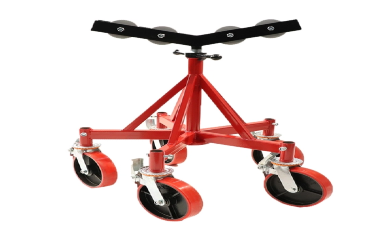
Adjustable stands feature threaded elevation adjustments. They often include interchangeable heads like V-heads and rollers. These features provide immense versatility on complex job sites. You simply spin the adjusting collar to raise or lower the pipe.
When managing longitudinal movement, a Roller Pipe Stand becomes absolutely necessary. It handles thermal expansion smoothly. The pipe glides back and forth over the wheels. This prevents destructive friction. For heavy-duty rotation during fabrication, you need a Rigid Roller Pipe Stand. It keeps massive pipes aligned while welders work. They can spin heavy spools effortlessly.
These tools offer core advantages for dynamic environments:
Field Flexibility: They easily compensate for uneven terrain. You can fix slight engineering miscalculations without structural rework. You simply adjust the threads.
Thermal Management: They allow controlled pipe movement. The underlying support structure experiences no added stress. The system absorbs thermal shocks easily.
Welding Efficiency: They remain crucial for pipe alignment. Welders rely on them for precise rotation during spool fabrication. This prevents back injuries and speeds up production.
You must also consider their limitations carefully. They require a higher upfront unit cost. Moving threads demand baseline maintenance. Highly corrosive environments can degrade these moving parts quickly.
Common Mistake: Operators often forget to lubricate the threaded adjustments. Over time, rust freezes the threads completely. This turns an expensive adjustable stand into a rigid one. Establish a strict preventative maintenance schedule for all moving parts. You must apply anti-seize compounds regularly. Dust and debris can clog the threaded rods. Routine cleaning becomes a mandatory operational task.
Comparing your options requires a clear framework. You must evaluate load compatibility alongside specific process needs. Heavy materials like ductile iron pipe demand specialized adjustability. You also need to assess the installation environment. Gravel and grated flooring pose unique challenges compared to flat concrete.
Let us look closely at load dynamics. Dead weight pushes straight down. Fixed stands handle this efficiently. Dynamic loads introduce movement, vibration, and shifting forces. Adjustable stands absorb these variables better. When evaluating terrain, remember how outdoor sites change. Rain washes away loose gravel. Ground freezes and thaws throughout the year. These environmental shifts alter the elevation of your supports. An adjustable unit lets you re-level the pipeline quickly during seasonal maintenance. A fixed unit forces you to rebuild the entire foundation pad.
You must balance the cost of labor against initial CapEx. Fixed stands cost less upfront. However, fine-tuning adjustable stands on-site saves countless labor hours. If a crew spends two hours modifying a rigid support, your labor costs skyrocket. The adjustable stand pays for itself immediately during installation.
Process specificity requires deep analysis. You must look at the entire lifecycle of the pipe. Fabrication yards operate purely on speed and precision. Welders cut, align, and join pipe sections continuously. Adjustable stands facilitate this rapid workflow perfectly. They allow crews to spin materials freely. Conversely, permanent infrastructure demands immovable stability. Once a utility line goes live, it should remain undisturbed. Fixed supports provide this long-term peace of mind. You install them once. You never adjust them again.
Evaluation Criteria | Fixed Pipe Stands | Adjustable Pipe Stands |
|---|---|---|
Load & Material Handling | Excellent for static, vertical dead weight. | Adapts to dynamic loads and rigid materials. |
Installation Terrain | Requires perfectly level, flat concrete. | Handles gravel, unlevel grade, and grated floors. |
Labor vs CapEx Balance | Low initial cost; high labor for field changes. | Higher upfront cost; massive labor hours saved. |
Process Specificity | Permanent, predictable infrastructure setups. | Temporary fabrication, welding, and thermal lines. |
Safety always dictates your final equipment choices. You must check load rating certifications thoroughly. ASME piping standards strictly govern thermal movement and load distribution. These codes define exactly how a pipe should rest safely. Ignoring them invites legal and operational disasters. It requires designers to account for all concurrent loads. You must calculate wind loads, seismic activity, and thermal expansion simultaneously. Documenting your compliance protects your company from liability.
Never exceed the safe working load (SWL). Threading adjustable stands to their absolute maximum height reduces their stability. The center of gravity shifts upward dangerously. Always consult the manufacturer load charts before extending the threads fully. Keep the stand height within the optimal middle range.
Watch out for the trap of over-engineering. Do not buy premium adjustable stands for a basic utility line. A simple fixed bracket works perfectly for low-risk, static applications. Buying unnecessary features wastes your project budget quickly. Engineers sometimes specify complex rollers for cold water PVC lines. This represents a fundamental misunderstanding of resource allocation. Keep things simple when the environment allows it.
Consider the impact of localized weather conditions. High winds exert tremendous lateral forces on exposed pipelines. Fixed brackets resist these sheer forces naturally. Adjustable stands require extra bracing to achieve similar lateral stability. You must account for these environmental stressors during the design phase. Failing to brace an elevated line properly leads to catastrophic swaying.
We also learn important adoption lessons from the field. Mechanical vibration induces loosening over time. The threaded collars can slowly unscrew themselves. You must require locking mechanisms on all adjustable threads. Set screws or locking nuts prevent this dangerous drift. Routine inspections keep these systems secure.
Best Practice: Require third-party certifications for all heavy-duty supports. Do not rely solely on internal vendor testing. Reputable manufacturers gladly provide independent lab results. These documents verify their safe working load claims objectively. Routine maintenance protocols must reflect your support choices. Fixed systems require basic visual inspections annually. Adjustable systems demand more rigorous oversight. Maintenance teams must verify torque specs on locking nuts. You must build these labor hours into your operational budgets.
Fixed stands clearly win on initial cost. They belong in static, perfectly measured environments. They offer unparalleled durability because they lack moving parts. However, they punish measurement errors severely. Adjustable stands act as an insurance policy. They protect against field variables and unexpected thermal movement. They dominate the fabrication sector entirely. Welders simply cannot work efficiently without them.
We recommend engineers audit their sites carefully. Review your terrain, thermal movement calculations, and installation labor budgets. Do this before issuing any purchase order. Accurate site data prevents costly purchasing mistakes. Walk the actual job site. Look for sloping floors, tight corners, and temperature extremes.
Contact an engineering specialist today. Review your specific piping isometric drawings together. You can also consult a detailed sizing guide or product catalog. These next steps ensure you select the safest, most efficient support system. Proper planning guarantees project success from day one.
A: It is highly discouraged. Welding requires precise fit-up and often pipe rotation. An adjustable stand with roller heads is standard industry practice for fabrication.
A: Yes, provided the stand is explicitly load-rated for the pipe's weight and diameter. Heavy-duty rigid roller pipe stands are specifically engineered for these dense materials.
A: Use a V-head for static support or minimal movement. Specify a roller head when the pipe must be rotated during welding or when it will experience significant linear thermal expansion.