
Views: 0 Author: Site Editor Publish Time: 2026-07-30 Origin: Site


Selecting the right equipment represents a critical safety and efficiency decision. It is never just a minor tooling purchase for your shop. In high-stakes environments like industrial fabrication and demanding energy sector projects, inadequate pipe handling causes serious issues. Unstable supports lead directly to weld contamination, frustrating workflow bottlenecks, and severe safety hazards. Fitters and welders cannot perform optimal work when their materials shift unpredictably under heavy loads. You need total stability to maintain production speed.
The choice between four-wheel and five-wheel configurations comes down to load distribution, shop floor realities, and pipe diameter. This guide breaks down exactly how you should evaluate both options. We base our recommendations on structural physics and real-world production outcomes. You will learn how to match your specific fabrication requirements with the correct equipment geometry.
Four-wheel stands (e.g., the H405) offer a balance of maneuverability and standard load capacity, ideal for mid-sized spools and tight workshop layouts.
Five-wheel stands (e.g., the H406) provide superior anti-tip stability and enhanced load distribution for oversized, heavy-wall pipe rotation.
Mobility vs. Footprint: A five-wheel base demands more floor space but drastically reduces the risk of tipping during dynamic loads.
Material matters: The choice of roller wheel material (steel, polyurethane, rubber) is as critical as the stand configuration to prevent cross-contamination.
Upgrading your shop equipment delivers measurable improvements in daily operations. Outdated or undersized equipment exposes your crew to unnecessary physical dangers. Modern pipe standing tools must safely handle tremendous rotational forces during everyday fabrication tasks.
Proper stand selection minimizes OSHA-reportable incidents on your floor. Tip-overs and dropped loads cause catastrophic injuries and damage expensive materials. Modern, rated stands lock securely in place and maintain low centers of gravity. This structural stability keeps your shop fully compliant. It protects your workforce from sudden equipment failures during heavy lifts.
A properly specified mobile pipe stand eliminates the constant need for crane repositioning. Welders and fitters can push spools manually across the shop floor. They work continuously instead of waiting around for overhead lifting equipment. This seamless movement drastically cuts project lead times. You gain significant operational momentum when workers control their own material handling.
Stable rotation dictates final weld quality. Root passes require extreme consistency from the operator. Wobbling pipes change the arc length unpredictably. Unstable rotation ruins shielding gas coverage, leading to porosity. You avoid these defects by using rock-solid supports. This precision proves especially crucial in critical oil pipeline support applications. Such demanding sectors operate with nearly zero defect tolerances.
The standard four-point caster base design dominates many modern fabrication shops. It relies on a compact square or rectangular footprint. This geometry offers highly predictable load distribution for standard weights. Operators can push and pull the equipment easily in multiple directions. The four-wheel configuration delivers incredible maneuverability across tight shop spaces.
We consistently view the H405 pipe stand as the industry benchmark for four-wheel capability. It balances structural rigidity against lightweight maneuverability perfectly. This stand handles everyday spools confidently without straining your crew.
Compact Footprint: You can navigate it quickly through congested shop floors. Narrow aisles present no problem for this slim profile.
Versatility: Manufacturers often design this as a foldable pipe stand. Folding capability allows rapid deployment in tough field environments. Crews toss them into truck beds quickly for remote repairs.
Exceptional Utility: These models handle roughly 70-80% of standard fabrication tasks. They easily support standard wall pipe up to 24 inches in diameter.
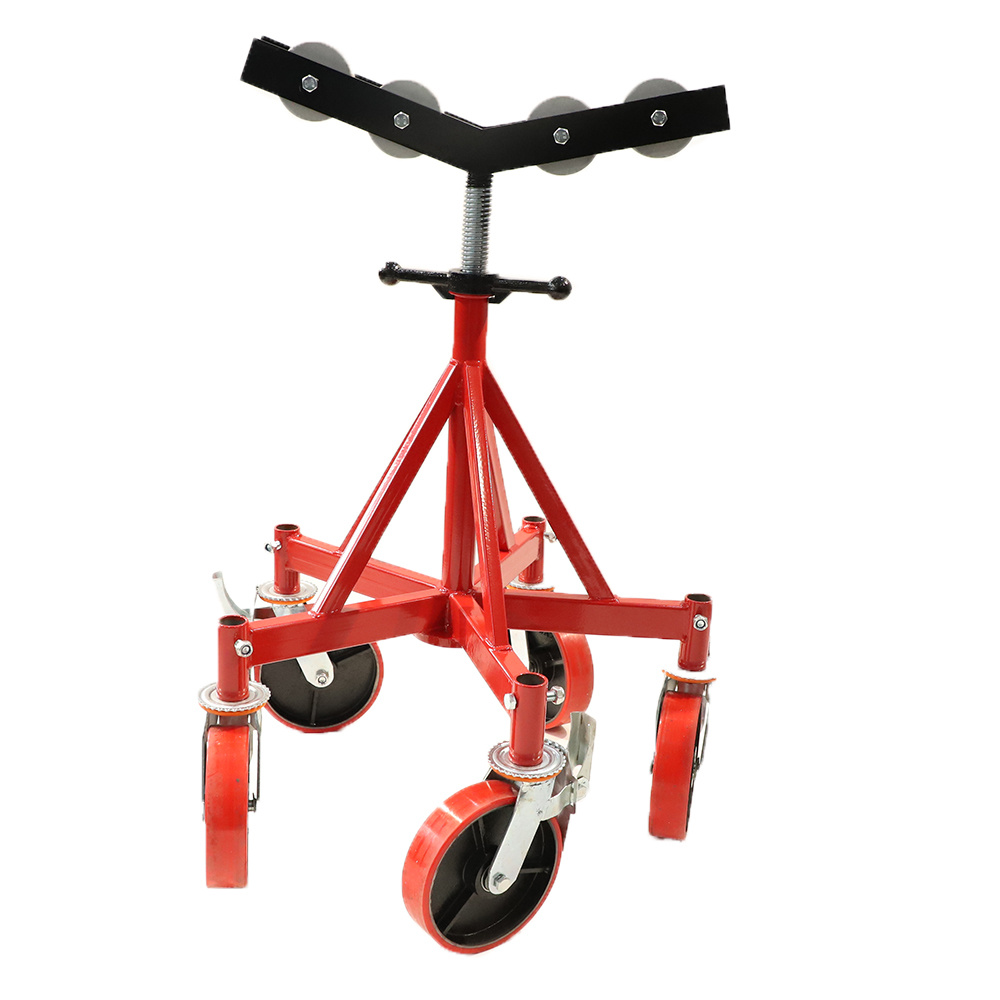
A five-point base geometry changes the physics of material handling completely. The extra ground contact expands the stability triangle outward. It absorbs lateral energy efficiently during aggressive pipe rotation. The center of gravity remains securely locked inside the wider base. This physical design acts as a massive anchor against unpredictable shifting forces.
Look at the H406 pipe stand to understand true heavy-duty engineering. Engineers designed it specifically for maximum anti-tip resistance. It tackles massive, off-center spools confidently. This unit handles the most aggressive shop environments without flinching.
Maximized Anti-Tip Geometry: The critical fifth point of contact stabilizes the entire structure. You need this feature when handling pipes carrying heavy flanges or offset valves.
High Load Capacity: Better weight distribution inherently reduces stress on individual casters. The wheels roll smoothly without flattening under extreme pressure.
Large Diameter Handling: Massive infrastructure projects demand zero pipe sagging during assembly. This setup proves perfect for supporting those massive, heavy-wall spools securely.
They consume valuable floor space during operation and storage. The wider base demands clear turning radii in your aisles. They weigh significantly more than four-wheel variants. You will not move them easily between remote field locations. They belong primarily on flat, dedicated shop floors.
You need a clear method to compare these support systems accurately. Look past basic catalog numbers before making a decision. Understand exactly how the equipment behaves during actual fabrication conditions. We break down the technical factors below.
You must understand the difference between these two ratings. A stand holding a stationary pipe experiences static load. A stand supporting a rotating pipe experiences dynamic load. A slightly bent pipe creates rhythmic lateral pushing forces while turning. Five-wheel models absorb these dynamic forces beautifully. Four-wheel models might wobble dangerously under those exact same conditions.
Roller head material dictates the purity of your final product. You must use steel wheels for standard carbon steel pipes. You should switch immediately to polyurethane or nylon wheels for stainless metals. This simple swap prevents disastrous carbon contamination. Scratched stainless steel will inevitably rust if you ignore this rule.
You will encounter acme threads and standard locking pins. Acme threads allow for precise micro-adjustments under heavy loads. You can level massive spools perfectly for welding. Locking pins offer fast, secure macro-adjustments. They lock tightly but lack fine-tuning capabilities. Choose threaded mechanisms for critical fit-up tasks.
Your shop floor dictates caster performance heavily. Uneven concrete joints catch small wheels easily. The load shifts violently when a wheel snags a crack. Five-wheel stands bridge uneven gaps safely due to distributed contact. Four-wheel models demand smoother concrete surfaces for safe transport.
The evaluation chart below compares base performance metrics between the two standard configurations:
Performance Metric | Four-Wheel Configuration | Five-Wheel Configuration |
|---|---|---|
Dynamic Load Stability | Moderate (Best for concentric pipes) | Exceptional (Handles severe eccentricity) |
Shop Floor Agility | High (Navigates tight aisles easily) | Low to Moderate (Requires wider turning radius) |
Surface Forgiveness | Requires smooth, flat concrete | Absorbs uneven joints effectively |
Purchasing incorrect tooling creates long-term operational friction for your team. We see shops make similar specification errors repeatedly. Avoid these common traps to protect your crew and maintain high productivity.
Buying massive five-wheel stands for small pipes wastes precious resources. Large stands consume valuable aisle space unnecessarily. They kill shop mobility entirely for minor tasks. Conversely, buying weak stands invites absolute disaster. An undersized frame will collapse eventually under heavy, eccentric spools.
An excellent steel frame means nothing riding on cheap wheels. Poor casters flatten rapidly under sustained heavy loads. Workers cannot push a stand effectively on flat-spotted wheels. You must prioritize forged steel or high-grade polyurethane casters for longevity.
Audit your maximum pipe sizes handled over the last twelve months. Document the heaviest weights accurately.
Assess your primary working environment. Measure aisle widths carefully and inspect concrete conditions for major cracks.
Determine your exact shop-to-field work ratio. High field deployment demands portable, folding equipment.
Match your documented needs to proper configurations. Select adequate models based strictly on factual operational data.
Four-wheel stands act as the versatile workhorses of the industry. They handle daily fabrication tasks efficiently and safely. They maneuver easily through crowded shop floors. Five-wheel stands provide mandatory insurance for extreme weights. They dominate complex rotational setups where safety is paramount. You absolutely need their enhanced stability for massive, eccentric loads.
Review your current equipment load certifications today. Inspect all casters and frames for dangerous wear. Consult a technical specialist regarding your upcoming project schedules. Match your required pipe schedules to the correct structural support. Proper equipment ensures safer working conditions and significantly faster project delivery.
A: The H406 configuration typically supports significantly higher dynamic loads due to its five-point base geometry. While industry benchmarks suggest four-wheel models handle standard capacities well, five-wheel variants handle oversized, eccentric weights much more safely. You must always refer to specific manufacturer specification sheets to confirm exact load ratings.
A: Yes, they are safe provided they feature engineered locking gussets. They must be explicitly rated for the specific pipe weight you intend to handle. Foldable designs do not inherently lack structural integrity. However, they do require stricter pre-use inspections to ensure all locking mechanisms engage properly before lifting.
A: You should specify slip-on polyurethane wheel covers or specialized stainless steel roller heads. Avoid using standard carbon steel wheels when handling stainless or exotic metal pipes. This simple material swap effectively eliminates cross-contamination risks during rotation and daily fit-up processes.
A: Yes, they handle rotation well, but rotational speed and pipe concentricity remain critical factors. If the pipe is slightly out-of-round, the shifting center of gravity creates lateral instability. For heavily eccentric loads, we strongly recommend a five-wheel stand to safely absorb those dangerous shifting forces.