
Views: 0 Author: Site Editor Publish Time: 2026-08-24 Origin: Site


Selecting the right pipe support equipment goes beyond mere convenience. It remains a critical safety and precision requirement. A mismatched stand compromises weld quality, risks catastrophic failure, and abruptly halts project timelines. Unfortunately, procurement teams and site managers often oversimplify this equipment selection. They rely heavily on generalized jack stands. These basic supports frequently fail under dynamic loads or extreme pipe diameters. You cannot afford this risk on high-stakes industrial projects. This article provides an evidence-based, technical evaluation framework. We will help you accurately choose a pipe stand for pipe size and weight requirements. You will learn how to eliminate guesswork in bottom-of-funnel procurement decisions. By mastering these principles, you ensure total operational safety and protect your fabrication workflow.
Weight capacity must account for both static resting weight and dynamic rotational forces during welding or threading.
Pipe outer diameter (O.D.) dictates the required head style—using an incompatible head type risks pipe slippage and stand tipping.
Heavy-duty applications (e.g., petroleum sectors) require certified, specialized supports rather than standard adjustable workshop stands.
Evaluating footprint stability, height adjustability, and head interchangeability prevents premature equipment replacement.
Many procurement professionals fall victim to the weight fallacy. They look at a manufacturer’s maximum weight rating and assume it applies to all working conditions. This specification almost always reflects a static load. A static load assumes the pipe rests completely still on the support. Real-world fabrication rarely involves stationary pipes. When workers turn, thread, or weld a spool, they introduce dynamic loads. These rotational forces shift the center of gravity momentarily. A sudden jerk from a pipe wrench or an automated positioner multiplies the stress placed on the stand’s frame. Ignoring these dynamic forces leads to dangerous equipment failures.
You must establish strict safety margins to protect your crew. The industry-standard baseline requires a 2:1 or 3:1 safety factor. Suppose your pipe spool weighs 1,500 lbs. If you select a stand rated for exactly 2,000 lbs, you operate dangerously close to failure limits during active fabrication. For a 1,500 lb active load, you should ideally select supports rated for at least 3,000 lbs. This buffer absorbs the shock of sudden movements. It also accounts for unintended lateral forces applied by operators.
Long pipe spools complicate load calculations. You cannot simply divide the total weight by two and place a stand at each end. Long pipes naturally sag in the middle. This sag forces the outer supports to bear uneven stress angles. You must calculate weight distribution across multiple supports carefully.
Best Practice for Load Distribution:
Always support the pipe at intervals preventing more than 1/8-inch of sag.
Place the primary supports roughly 20% of the pipe's length inward from each end.
Add intermediate supports for any spool exceeding 20 feet in length.
Recalculate the weight per stand assuming one stand might bear up to 60% of the load due to uneven flooring.
Every stand features minimum and maximum outer diameter (O.D.) ratings. These boundaries matter immensely for rotational stability. If you place an undersized pipe in a massive V-head, the pipe lacks stable contact points. It will wobble during rotation. Conversely, placing an oversized pipe on a narrow stand alters the center of gravity. The pipe sits too high above the central column. This height creates a severe tipping hazard. You must strictly adhere to the manufacturer's O.D. ratings to maintain safe contact geometry.
Pipe wall thickness dramatically alters the physical footprint required for safe support. Two pipes might share the exact same O.D., but their weights differ wildly based on their schedule. A Schedule 40 pipe behaves very differently than a Schedule 160 pipe. Heavier, thicker pipes carry a denser core. They require wider bases to prevent lateral tipping. Even if the O.D. fits perfectly into the stand's head, the sheer density of a thick-walled pipe might overwhelm a narrow base.
Impact of Pipe Schedule on Weight (Per 100 ft of 12-inch Pipe)
Pipe O.D. (Inches) | Schedule | Wall Thickness (Inches) | Approx. Weight per 100 ft (lbs) |
|---|---|---|---|
12.75 | Sch 40 (Standard) | 0.406 | 5,352 |
12.75 | Sch 80 (Extra Heavy) | 0.688 | 8,863 |
12.75 | Sch 160 | 1.312 | 16,028 |
Clearance around the pipe dictates how easily your team can work. Orbital welding equipment requires significant clearance underneath the pipe. If a stand's minimum height setting leaves the pipe too close to the floor, automated welders cannot complete a full 360-degree rotation. Manual welders also need ergonomic access. Always measure the clearance required for your largest welding clamps. Compare this against the stand's lowest possible height setting before making a purchase.
The head style dictates how the pipe interacts with the support. A standard V-head features rigid, angled steel plates. These are excellent for static alignment. Use them when you need to tack weld two pieces together without any movement. However, they create immense friction if you attempt to turn the pipe.
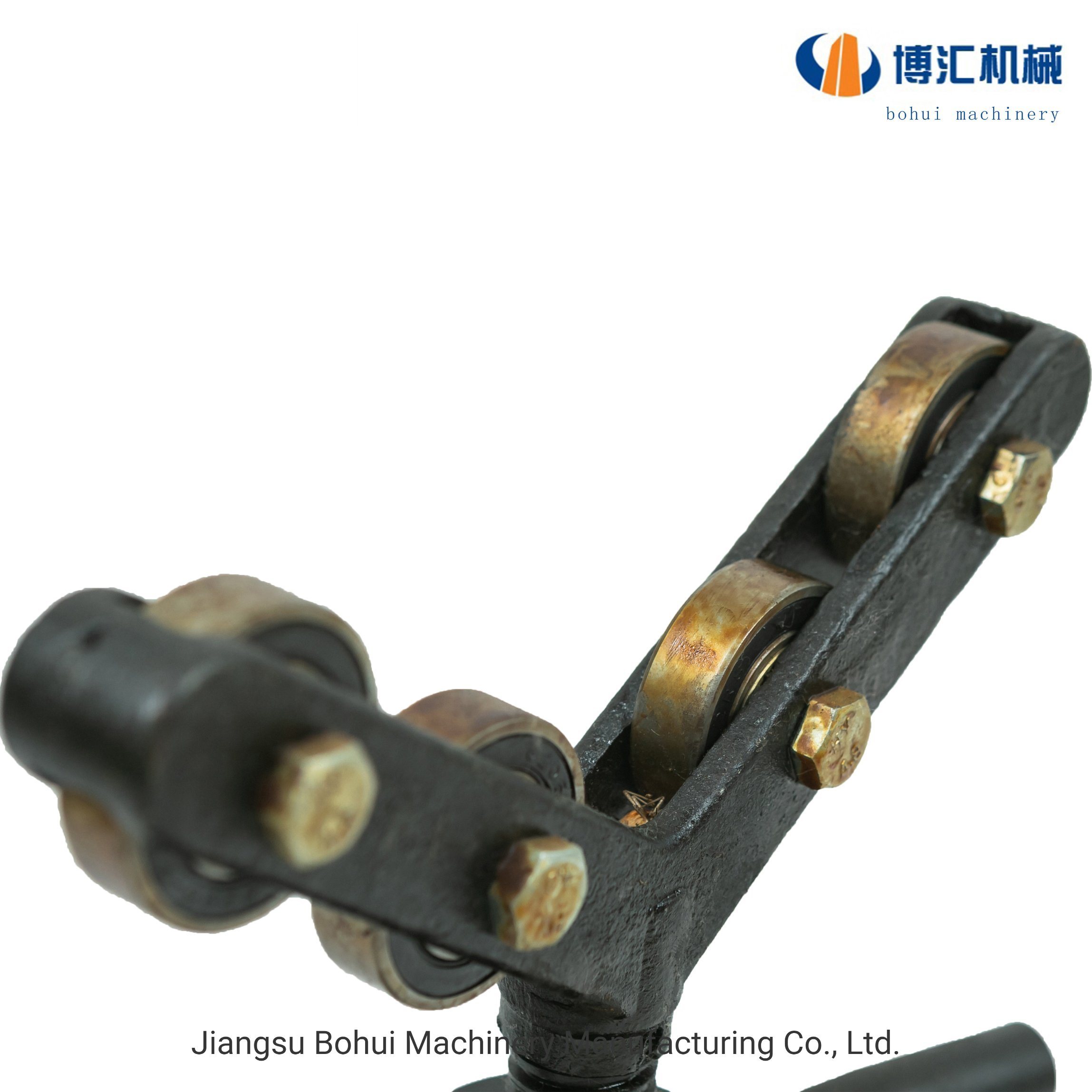
For dynamic fabrication, you need specialized equipment. Integrating a Heavy-Duty Roller Pipe Stand is essential for smooth, continuous rotation. Rollers allow the operator to turn heavy spools by hand or alongside automated positioners. This reduces operator fatigue significantly. It also prevents the stand from gouging the pipe’s exterior surface during rotation.
Not all rollers serve the same purpose. You must match the roller material to your pipe metallurgy.
Steel Wheel Rollers: Ideal for carbon steel. They bear massive loads but can cause surface marring.
Nylon Rollers: Mandatory for stainless steel, aluminum, or exotic alloys. They prevent iron particle cross-contamination, which leads to localized rust.
Ball Transfer Heads: These allow for multi-directional movement. You can push the pipe longitudinally into a threading machine or rotate it on its axis.
Threading and grooving operations generate intense vibrations. A standard gravity-fed roller head might allow the pipe to bounce out of alignment. To solve this, you need secure, semi-permanent clamping. Utilizing a Bracket B Pipe Stand configuration locks the pipe firmly down. These specialty top brackets clamp over the O.D., holding the pipe securely against the rollers or V-head. This eliminates chatter during heavy machining processes.
Every adjustable unit relies on a locking mechanism to hold the load at height. The quality of this mechanism determines the safety of the entire rig. When evaluating an Adjustable Pipe Stand, scrutinize the primary lock. Simple pin-locks often suffer from sheared pins under shock loads. They also lack fine-tune adjustability.
The superior design utilizes a heavy-duty locking ring combined with a set-screw. The operator spins the locking ring up the threaded column to the exact millimeter required. Then, they tighten the set-screw (often a T-handle) to eliminate internal column play. This dual-action lock prevents micro-slippage when heavy loads are placed onto the stand.
Portability often conflicts with maximum capacity. You must choose the base design based on the primary working location.
Folding Legs: These offer high portability. Workers can carry them easily into the field. However, folding joints introduce structural weak points. They inherently possess lower weight capacities.
Fixed/Solid Stance: These feature fully welded A-frame bases. They are required for permanent fabrication shop installations. A fixed base handles heavy-wall pipes without structural deflection.
The spread of the legs (stance width) correlates directly to the maximum safe height extension. As you raise the central column, you raise the payload's center of gravity. A narrow base cannot safely support maximum weight at maximum height. If an operator pushes the pipe laterally while the stand is fully extended, a narrow base will tip over. Always verify that the manufacturer certifies the maximum weight rating at the fully extended height, not just at the lowest setting.
Field fabrication rarely happens on flat, clean concrete. In the oil and gas sector, workers contend with mud, uneven grating, and gravel. Standard workshop bases sink into soft soil. When evaluating Petroleum Pipeline Support equipment, look for specialized adaptations. You need wide-stance feet, often called "mud shoes," to distribute weight over soft ground. Some models feature trench-ready bases designed to sit securely inside a dug pipeline trench without collapsing inward.
Never bypass safety certifications for cost savings. Enterprise-level projects demand strict compliance with CE, OSHA, or localized safety standards. Procurement departments should automatically reject undocumented, unrated imported stands. A certified stand comes with documented proof of load testing. If an accident occurs on site, using uncertified equipment opens your company to massive liability and severe regulatory fines.
A stand is only as strong as the floor beneath it. You might purchase a stand rated for 5,000 lbs. However, if you place it on uneven concrete, only three of the four legs might make contact. This uneven stance instantly destroys the stand's rated capacity.
Common Mistakes to Avoid:
Using wood shims to level a stand carrying heavy-wall pipe. Wood compresses and shifts.
Ignoring floor slope. A severely sloped floor introduces lateral shear forces against the central column.
Deploying heavy-duty casters without engaging the physical floor locks before welding.
Proper site assessment remains an absolute prerequisite to stand deployment.
Selecting the right pipe support requires analytical thinking rather than guesswork. You can streamline this process using a clear decision matrix. First, calculate the maximum dynamic weight by applying a 2:1 safety margin to your heaviest spool. Second, identify the specific O.D. range and ensure it falls within the manufacturer's safe limits. Third, select the appropriate head style—such as nylon rollers for stainless steel or clamping brackets for high-vibration threading. Finally, verify the environmental footprint, ensuring the base design matches your shop or field floor conditions.
Take immediate action by auditing your current fabrication requirements. Document your heaviest and largest pipe projects, then add a 25% future-proofing margin to those figures. Contact your vendors and request official spec sheets, load test documents, and certification papers before issuing any purchase orders. Proactive equipment sizing protects your workers and secures your project timelines.
A: The industry standard dictates at least a 2:1 safety ratio. If your pipe weighs 1,000 lbs, your stand must be rated for a minimum of 2,000 lbs. This buffer safely accounts for dynamic forces, shock loads, and uneven weight distribution that occur during active pipe rotation and welding.
A: No. Standard stands are insufficient for these demands. Petroleum applications require certified heavy-duty models with fixed, welded bases. They also need high-capacity roller heads to handle extreme static weights, thicker pipe schedules, and severe environmental instability found on remote job sites.
A: You must match head materials to prevent cross-contamination risks. Using carbon steel rollers on stainless steel or aluminum pipes embeds microscopic iron particles into the softer metal. This contamination rapidly causes localized corrosion and weakens the integrity of exotic alloy pipes.
A: Height adjustment drastically changes the leverage effect. As the stand extends to its maximum height, the payload's center of gravity rises. This increases the risk of lateral tipping. A stand must have a proportionally wide base to safely carry maximum weight at maximum extension.