
Views: 0 Author: Site Editor Publish Time: 2025-11-24 Origin: Site


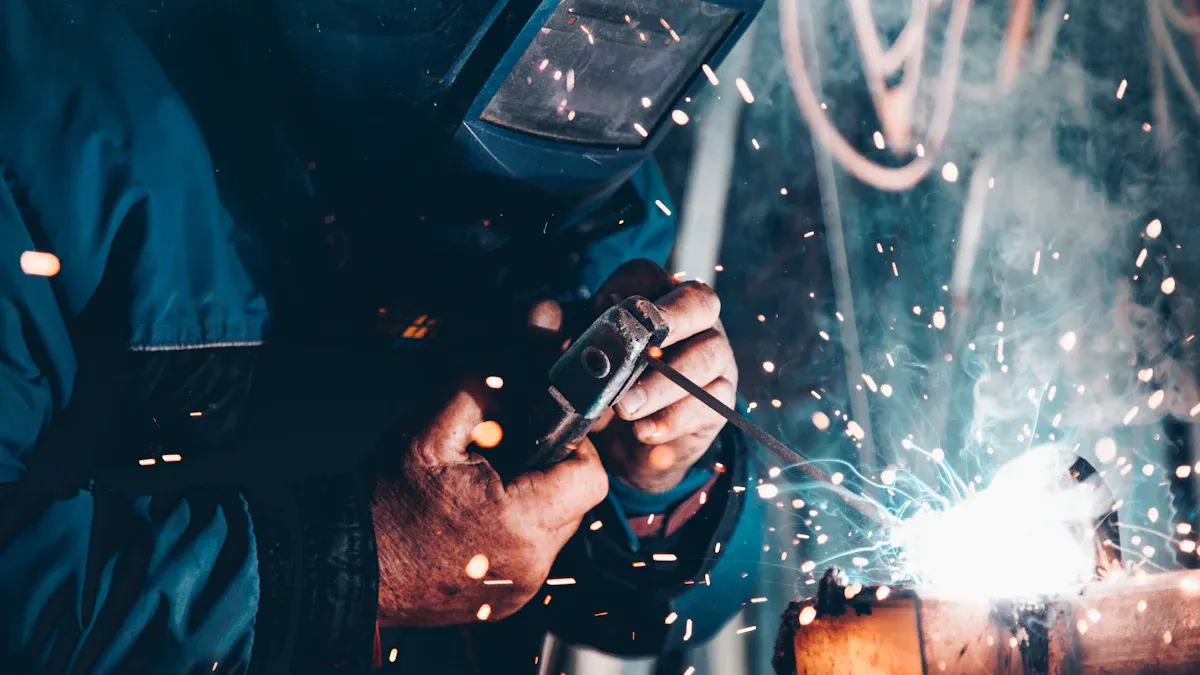
You use pipe welding to connect metal pipes. This makes a strong bond that does not leak. Pipe welding helps oil, gas, water, and chemicals move safely. It is used in pipelines in factories and buildings. Many industries need welding to build and fix these systems. The most common pipe welding techniques are:
Shielded Metal Arc Welding (SMAW)
Gas Metal Arc Welding (GMAW)
Flux-Cored Arc Welding (FCAW)
Submerged Arc Welding
Tungsten Inert Gas (TIG) Welding
Each method works best with certain materials. Each method is good for different situations. You pick the right technique for the job. This helps pipes stay safe and last a long time.
Pick the best pipe welding technique for the job and material. This helps make strong and leak-free connections.
Follow each step in the pipe welding process to prevent mistakes. Every part, from getting ready to checking the weld, is important for good welds.
Wear the right safety gear when you weld. Helmets, gloves, and special clothes keep you safe.
Try welding in many positions to get better at it. Learning different ways helps you work on many kinds of projects.
Check your welds carefully to find problems early. Regular checks help keep your pipe systems safe and strong.
You can choose from several pipe welding techniques when you join pipes for different projects. Each method works best in certain situations. You need to know the differences to pick the right one for your job. The main pipeline welding methods include SMAW, GMAW, GTAW, FCAW, and SAW. These techniques help you create strong, safe connections in many industries.
Tip: The right pipeline welding technique depends on the pipe material, the job site, and the type of joint you need.
Below is a table that shows the key applications and requirements for each method:
Welding Technique | Key Applications and Requirements |
|---|---|
SMAW | Needs low hydrogen electrodes; works well for jobs that require high-quality radiographs. |
GMAW | Good for root pass butt welding; has some limits for certain pipe parts. |
GTAW | Needs internal gas purge for some welds; wind can affect the process. |
FCAW | Used for pipe support fabrication; needs low hydrogen consumables and certain wind conditions. |
SAW | Needs multipass welding with automatic tools; has limits on weld thickness. |
You often use SMAW for pipeline welding in the oil and gas industry, construction, and manufacturing. This method uses a stick electrode to create the weld. You can use SMAW outdoors or in tight spaces because it does not need extra shielding gas. You get strong welds that pass strict tests.
Industry | Application |
|---|---|
Oil and Gas | Pipeline welding |
Construction | Structural steel welding |
Manufacturing | General fabrication and repair |
SMAW works well for many pipeline welding jobs. You can use it for repairs and new builds. You need to use low hydrogen electrodes to avoid cracks. You also need to follow rules for good weld quality.
GMAW, also called MIG welding, uses a wire electrode and shielding gas. You can weld many metals, like steel, aluminum, and stainless steel. GMAW gives you fast welding speeds and clean welds. You often use it for root passes in butt joints.
Here is a table that shows the advantages and disadvantages of GMAW:
Advantages of GMAW | Disadvantages of GMAW |
|---|---|
Faster welding speeds than other processes | Limited portability compared to SMAW |
Can weld a wide range of metals | Sensitive to drafts or outdoor conditions |
Excellent weld appearance and soundness | Needs special equipment and shielding gas |
Minimal slag and spatter | Harder to weld out-of-position |
You get smooth, neat welds with GMAW. You need to work in places with little wind, because drafts can affect the shielding gas. You also need special tools and a steady power source.
GTAW, or TIG welding, uses a tungsten electrode and shielding gas. You use this method when you need high-quality, precise welds. GTAW is great for thin-walled pipes and critical joints. You often use it for stainless steel and special alloys.
GTAW uses a non-consumable tungsten electrode for better precision.
You get welds that look good and are very strong.
The process uses less heat, which helps protect thin pipes.
You need to keep the area free from wind, because the shielding gas can blow away. You also need to use an internal gas purge for some welds to keep the inside clean.
FCAW uses a wire with flux in the center. You often use this method for pipe support fabrication and heavy-duty jobs. FCAW works well outdoors if you use the right consumables. You can weld faster than with SMAW.
Here is a table that shows how fast you can weld with different methods:
Process Type | Deposition Rate (lb/hr) | Time to Complete Weld (min) | Percent Difference |
|---|---|---|---|
SMAW (manual hot pass) | 1.5 - 5.1 | 95.4 | -- |
GMAW-P Hyperfill | 12.6 - 15.5 | 42.1 | 56% |
GMAW-MWSC & SAW-AC | N/A | 52.4 | 45% |
You can finish pipeline welding jobs faster with FCAW and GMAW than with SMAW. FCAW needs low hydrogen consumables and works best in certain wind conditions.
SAW uses a wire electrode and a layer of flux that covers the weld. You use SAW for large-diameter pipes in oil, gas, chemical, and petrochemical industries. This method is good for both onshore and offshore pipeline welding projects. SAW lets you weld thick pipes with automatic machines.
SAW pipes move fuels and chemicals safely.
You can use SAW for big pipeline welding jobs that need strong, leak-free joints.
SAW works best for straight, long welds on large pipes.
You need to use multipass welding and follow thickness limits for each weld. SAW is not for small or thin pipes.
Note: You can use orbital welding with some of these techniques, especially for pipes that need precise, repeatable welds. Orbital welding uses a machine to move the welding torch around the pipe. This helps you get even welds every time. You often use orbital welding in industries like food, pharma, and aerospace, where weld quality matters most.
You now know the main pipe welding techniques. You can choose the best method for your pipeline welding project by thinking about the pipe size, material, and job site. Orbital welding can help you get perfect welds in tough spots or when you need to repeat the same weld many times.
You need to follow a clear pipe welding procedure to get strong, leak-free joints. Each step in the process builds on the last one. If you skip a step or rush, you can end up with weak welds or costly repairs. The main pipe welding phases include preparation and alignment, tack weld and root pass, hot, fill, and cap passes, and final inspection. Good body positioning and careful technique help you get the best results at every stage.
Here is a table that shows the standard steps in a pipe welding procedure:
Step | Description |
|---|---|
1 | Clean the pipes thoroughly to remove contaminants. |
2 | Bevel the pipe edges to create a V-shaped groove. |
3 | Choose the appropriate welding technique based on material and thickness. |
4 | Set up the welding equipment and adjust parameters. |
5 | Apply the root pass for full penetration. |
6 | Fill the joint with multiple layers of weld metal. |
7 | Inspect the welded joint for defects. |
You start the pipe welding procedure by preparing the pipes. Clean the pipe ends until you see bright metal for at least one inch from the edge. This step removes oil, dirt, and rust that can cause defects. Next, bevel the pipe edges to make a V-shaped groove. This groove helps the weld metal flow and join the pipes fully.
Pipe fit-up and alignment come next. You must line up the pipes so the edges match perfectly. If you do not align the pipes well, you can get weak welds or leaks. Here are some problems that poor pipe fit-up and alignment can cause:
Misalignment can lead to improper fusion and not enough weld penetration.
A bad weld from misalignment makes the pipe less durable and increases stress.
Misalignment creates weak spots that can fail under pressure.
Take your time with pipe fit-up and alignment. Use clamps and tools to hold the pipes steady. Good alignment sets you up for success in the next pipe welding phases.
After you align the pipes, you move to tack welding. Tack welds hold the pipes in place so they do not move during the main weld. Make tack welds large enough and space them evenly around the joint. This keeps the pipes stable and helps you avoid gaps or shifting.
You should grind the tack welds to a feather edge. This step helps you avoid defects when you finish the weld. Tack welding is a key part of the pipe welding procedure because it keeps everything in place.
Next, you perform the root pass. The root pass is the first full weld that joins the inside edges of the pipes. Many welders use TIG welding for the root pass, especially for important jobs. Use a filler material to close the gap between the pipe edges. Make sure you have the right shielding gas and clean surfaces for a strong root pass.
You also need to check the root gap. The gap should be at least 1/32 inch bigger than the filler wire. This space lets you move the wire and get good fusion. Clean pipe ends and the right root gap help you avoid problems in later pipe welding phases.
Once you finish the root pass, you move to the hot pass. The hot pass melts and smooths the root pass, removing any trapped slag or defects. You need to keep your body steady and use smooth movements. Good body positioning helps you control the weld pool and avoid mistakes.
After the hot pass, you add fill passes. Fill passes build up the weld joint with more layers of weld metal. You may need several fill passes, depending on the pipe thickness. Each layer must bond well with the last one. Use the right welding technique and keep a steady hand.
The last step is the cap pass. The cap pass covers the joint and gives it a smooth, finished look. It also protects the weld from damage. You want the cap pass to be even and free from holes or cracks. Good technique and body control help you get a strong, neat cap.
The last phase in the pipe welding procedure is the final inspection. You check the weld for defects that can cause leaks or failures. Inspectors use special tools like X-rays or automated ultrasonic testing (AUT) to find hidden problems.
Here is a table that shows common defects and how you can find them:
Defect Type | Description | Detection Method |
|---|---|---|
Misalignment | Difference in heights of pipes, weakening the weld. | X-ray, AUT |
Excessive Penetration | Excess weld metal protruding through the weld root. | X-ray, AUT |
Root Concavity | Shallow groove in the weld root due to pool shrinkage. | X-ray, AUT |
Cracking | Serious defect leading to weld failure due to internal stresses. | X-ray, AUT |
Lack of Penetration | Weld fails to fuse properly to the base metal. | X-ray, AUT |
Incomplete Fusion | Similar to lack of penetration, where the weld does not fuse adequately. | X-ray, AUT |
Undercut | Groove or notch at the weld toe, weakening the joint. | X-ray, AUT |
You need to fix any defects before the pipe goes into service. Careful inspection makes sure your pipe welding job is safe and reliable.
Tip: Always pay attention to your body position and movement during each step. Good posture helps you control the torch and make better welds.
By following each step in the pipe welding procedure, you can create strong, long-lasting joints. Careful preparation, alignment, and inspection help you avoid problems and keep your work safe.
You need special tools and supplies for pipe welding. Each one helps you make strong, safe pipe joints. You must pick machines, filler materials, and safety gear that fit your project.
There are different welding machines for pipe jobs. Each machine is best for certain tasks and metals. The most common machines in factories are:
MIG welders
TIG welders
Stick welders
Multi-process welders
MIG welders let you work fast and make neat welds. TIG welders give you control for thin pipes and special metals. Stick welders are good for outdoor jobs and small spaces. Multi-process welders let you change methods for different work. You also need simple tools like clamps, grinders, and wire brushes to get pipes ready and finish welds.
You must pick the right electrodes and filler materials for each job. Electrodes carry electricity and melt to make the weld. Filler materials add strength and fill spaces between pipe edges. You choose electrodes by looking at the pipe metal, thickness, and welding method.
Electrode Type | Best Use Case | Notes |
|---|---|---|
Low hydrogen | High-strength steel | Reduces risk of cracking |
Stainless steel | Corrosion resistance | Used for food and chemical pipes |
Aluminum | Lightweight pipes | Needs special technique |
Low hydrogen electrodes help you make strong welds that do not crack. Stainless steel electrodes are for pipes that move food or chemicals. Aluminum electrodes are for light pipes. Always match the filler material to the pipe metal for the best weld.
You must wear safety gear when you weld. Safety rules say you need personal protective equipment (PPE) in dangerous places. This gear keeps you safe from heat, sparks, fumes, and loud sounds.
In risky areas, you need a mask to keep out bad fumes. Special clothes protect your skin from burns and chemicals. Welding helmets keep your eyes and face safe from bright light and flying bits. You also need gloves, jackets, boots, and ear protection.
Respiratory protection
Protective clothing
Eye protection (welding helmets and goggles)
Welding gloves
Welding jacket
Welding boots
Hearing protection
Helmets and goggles keep your eyes and skin safe from sparks and heat. Gloves protect your hands from burns and hot metal. Jackets and boots keep you safe from sharp things and high heat. Ear protection helps you avoid hearing loss from loud noise.
Tip: Always check your safety gear before you start welding. Good PPE keeps you safe and helps you do your best work.
You need the right tools and supplies for every pipe welding job. Good machines, the right electrodes, and strong safety gear help you stay safe and make good welds.
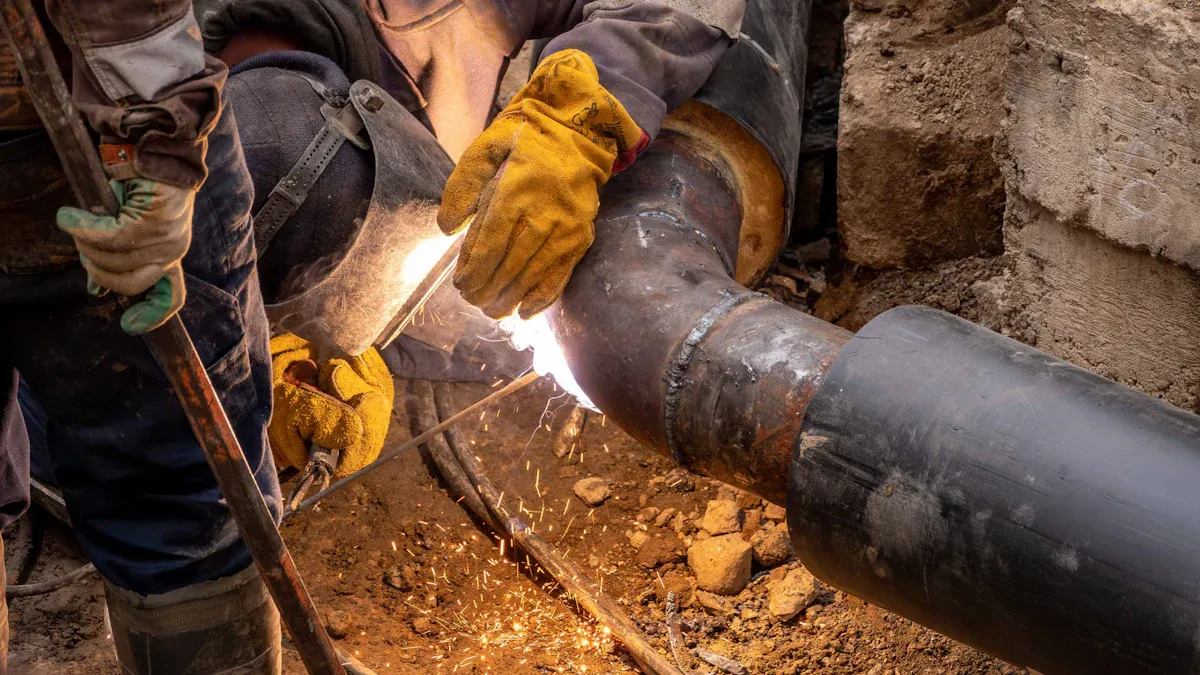
You need to know the main types of pipe joints before you start welding. Each joint type has a special use in industry. The right joint helps you get strong, leak-free connections.
You use a butt joint when you want to join two pipes end to end. This joint is common in high-quality piping systems. You often see butt joints in pipelines, fittings, and valves. Butt joints give you the highest tensile strength compared to other joints. You get a smooth inside surface, which helps fluids flow easily.
Type of Joint | Shear Strength (MPa) | Tensile Strength (MPa) |
|---|---|---|
Lap Joint | 159.3 | N/A |
Butt Joint | N/A | 375.9 |
Butt joints work best when you need strong, reliable welds that resist leaks.
You use socket joints for small-diameter pipes. The pipe fits into a socket, and you make a fillet weld around the edge. Socket joints save space and give you high structural integrity. You get less risk of leaks because you do not need a full penetration weld. The smooth interior helps fluids move without much resistance.
Advantages of socket joints:
Compact and space-efficient
High structural integrity
Reduced risk of leakage
Smooth fluid flow
Easy alignment during installation
You often see soldered end joints in plumbing. You heat the pipe and fitting, then add solder to seal the joint. Soldered ends work well for copper pipes in water systems. You must clean off any leftover flux, or you risk corrosion and leaks.
Failure Mode | Description |
|---|---|
External Pitting Corrosion | Residual flux causes pinhole leaks in copper pipes. |
Improper Solder Connection | Poor surface prep leads to weak joints. |
Galvanic Corrosion | Dissimilar metals corrode quickly in humid places. |
Tip: Always wash off flux after soldering to prevent corrosion.
You use flanged joints when you need to connect pipes to valves or equipment. Flanged joints use gaskets and bolts to seal the connection. You can take these joints apart quickly for repairs or maintenance. This feature saves you time and reduces costs.
Flanged joints allow for quick disassembly.
You get easy access for repairs and replacements.
Proper alignment and bolt torque keep the joint leak-free.
You use mechanical fusion joints for plastic pipes. These joints include butt fusion, electrofusion, and socket fusion welding. You heat the pipe ends and press them together to make a strong bond. Mechanical fusion joints work well in water and gas lines.
Technique | Description | Key Features |
|---|---|---|
Butt Fusion Welding | Heats and presses pipe ends together. | Strong joint, good for high-pressure systems. |
Electrofusion Welding | Uses fittings with heaters to bond pipes. | Reliable in tight spaces, fits many pipe sizes. |
Socket Fusion Welding | Heats pipe and fitting, then joins them. | Simple and cost-effective for low-pressure systems. |
You need to choose the right joint type for your welding project. Each joint has its own strengths and best uses. When you match the joint to the job, you get safer and longer-lasting pipe systems.
You need good skills to do pipe welding well. You must learn how to use TIG, MIG, and Stick welding. You look at blueprints and drawings to know what to do. You fix problems fast when things go wrong. You pay close attention because small mistakes can be dangerous.
You learn how to weld pipes in different positions, like sideways, up and down, and above your head.
You get practice at trade schools or by working with experts.
You earn certificates from groups like the American Welding Society and the American Society of Mechanical Engineers.
Tip: Practice welding in every position often. This helps you stay safe and make strong welds no matter the job.
Pipe welding has many problems you must solve. If the weld does not go deep enough, the joint is weak. You fix this by going slower or turning up the power. Pipes can bend from heat, which is called distortion. You use clamps and heat thick pipes before welding to stop this. Cracks can happen too. You pick the right materials and cool the weld slowly to stop cracks.
You check your tools often to keep welds strong.
You get joints ready the right way for each welding method.
You change the shielding gas flow to stop defects.
You work in hard positions, like above your head or up and down, which need steady hands and good control.
Challenge | Solution |
|---|---|
Poor penetration | Go slower or turn up power |
Distortion | Use clamps, heat pipes first |
Cracking | Pick good materials, cool slowly |
Inconsistent welds | Check tools, inspect often |
Difficult positions | Practice and get better |
You must follow safety rules every time you weld. OSHA says you need shields that do not burn near walls that can catch fire. You keep your work area safe by moving or covering things that can burn. You wear a helmet or shield to protect your eyes and face. You wear gloves, boots, and jackets to keep your skin safe from sparks and heat.
You make sure your boss sets up safe places for cutting and welding.
You get training before working in dangerous pipe welding spots.
You use fans or vents so you do not breathe bad fumes.
Note: Always check your safety gear before you start. Good habits keep you safe and help you do your best work.
If you get good at pipe welding, you can make pipes that do not leak. These pipes will stay strong for a long time. When you watch the heat and line up the pipes right, you stop problems and keep everything safe. You should always:
Clean the pipes well and pick the right shielding gas.
Practice a lot and get certificates to learn more and find better jobs.
Learn about safety rules and new ways to weld for better work.
Keep working hard and learning new things. Your skills help every project go well.
You often use Shielded Metal Arc Welding (SMAW) for pipe welding. This method works well outdoors and in tight spaces. You get strong, reliable welds with SMAW.
You clean the pipe ends before welding. You use the right welding technique and filler material. You check your alignment and inspect your welds. Good preparation helps you avoid most defects.
Yes, you can weld pipes in flat, horizontal, vertical, and overhead positions. You need to practice each position. You use different techniques for each one to get strong welds.
You wear a welding helmet, gloves, jacket, and boots. You use eye and ear protection. You also use a respirator if you work in areas with fumes.
You inspect pipe welds to find cracks, leaks, or weak spots. Inspection helps you make sure the weld is safe and strong. You use tools like X-rays or ultrasonic testing for this job.